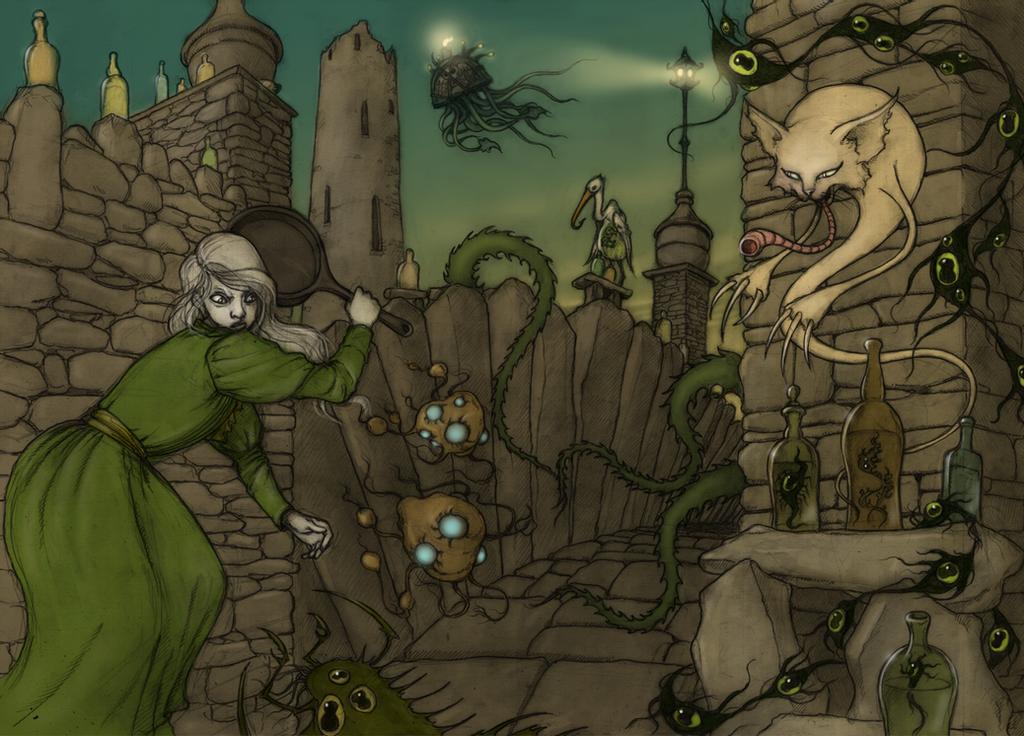
If you make your way along Gaunt Street, you will eventually come to the bridge of bottles, which crosses the Gaunt River. Hopeless has two towns, for there is an old town and a new town. No one lives in the old town – also known as Gaunt Town. That is not to say it is unoccupied.
Gaunt Town lies on the far side of the bridge of bottles. It is not a place for the living, or for anyone who intends to continue living. The tradition of putting bottles on the bridge is old – old enough that many people do it without knowing why they do it. This is as well for them, but only if they uphold the tradition.
The bottles keep the gaunts out.
Gaunts can only cross the river at twilight. However, like many creatures of folklore, they are susceptible to shiny things, to that which might need counting. They cannot resist checking the bottles. New things in bottles distract them. If there are enough bottles for them to check, they will not make it all the way across the river before the night settles. If they ever do make it all the way across it will not end well for the citizens of Hopeless, Maine.
Once upon a time, Gaunt Town was just the town. Further inland than the harbour, sheltered by a crook in the hills, it thrived. Briefly. The houses are empty of human life, now.
Make sure to leave a bottle at the bridge now and then. The gaunts like to be entertained. It is best if they do not cross the bridge looking for other things to shake the contents out of.
In the aftermath of broken bottles and stamped on night potatoes no one was entirely sure what had happened. No one even admitted to having been there. The most anyone would admit was knowing someone who knew someone who had been there. There were no witnesses because no one was willing to admit to having been there and witnessing the event and by mutual unspoken agreement those who had seen others in attendance and been seen themselves never spoke of it directly.
Everyone one was however more than happy to apportion blame, as ever.
In this case though that blame was easy enough apportioned. It was the fault of the newcomer. The man in the red-tailed jacket who had washed up on the shores of the island less than a month before in most unlikely circumstances. Barham P Bingley. Just how he had washed up in a old but well maintained circus wagon bearing his name in salt damaged, peeling paint, no one was entirely sure. The residents of Hopeless were also unsure just how he had convinced them to help tow his wagon up from the beach to a small meadow just along the road from the bridge of bottles. Other things of which they weren’t entirely sure of included why they had parted with coin, food stuff and other odds-n-sods to sit on uncomfortable wooden benches and watch ‘The World’s 2nd Greatest Showman’s’ put on his somewhat limited show for several nights on the trot. Mostly the audience just left each evening feeling a little sad and in no small part sorry for the little man in his faded red coat, with his battered top hat and painted smile.
The shows were however over by early evening and the audience could all repair to the squid and teapot for a couple of pints afterwards. Also the little man and his show was the kind of thing the residents of Hopeless expected to come to some tragic end. If it wasn’t for the fact his name was boldly escribed upon his wagon, it would have had pathos written all over it. And while they might deny it, the folk of Hopeless could never resist watching another calamity happen before their eyes. As such it became something of a vogue to attend the makeshift show for the first few weeks of what the locals laughably referred to as early spring. Which was one of those dismal fog laden moist springs that never quite got the hang of not been a late winter.
After the first couple of shows, and the merger takings from ‘the passing of the hat’ Barham himself began coming to the pub as well, mostly to get out of the fog for a while and nurse what could, if you were being kind and had never tasted the real stuff, be called a small brandy. Whence he would further ‘entertain’ the locals with talk of the many strange places and strange things he had seen. The wonders of his shows in Paris, Milan, New York , London and Dulwich. He also took pains to explain how once his circus once consisted of a dozen elephants, a trio of trained sealions, A pair actual lions and a tiger name King Stripentooth the third.
What had happened to King Stripentooth the second and first he would not say but King Stripentooth the fourth was one of the few animals that had remained in his circus when he arrived, a small domestic tomcat who’s fur had been badly dyed with orange stripes, much of which had washed out by ocean spray. King Stripentooth IV had run off after their second night and not been seen by Barham. However, he took heart in the appearance of the occasional rodent corpse presented at the foot the caravans step each morning which suggested the cat was thriving on the island.
The residents chose not to dissuade him of this notation or mention something else leaving the corpses of dead rodents for the showman to step into each morning was equally possible. This was Hopeless after all.
Late one evening in a near empty bar, after his least successful show so far, Barham was lamenting his lot. The veneer of outgoing upbeat cheerfulness had been chipped away earlier that day when the matinee performance had netted him the princely sum of a half rotten turnip and two carrots that had seen better days. He would not have minded so much if this pitiful return for his endeavours had been placed in the hat in the traditional manner, but hurling rotten vegetables at him seemed both ungracious and somewhat ungrateful of his audience, most of whom for the matinée had been children from the orphanage.
“They must have like the show.” One of the other drinkers, sagely told him. “Poor sods don’t have much to eat up there, though Davies does his best by them.”
There were nods all round at this latter comment. Barham chose to let it pass. His only interaction with the islands resident man of god had been when the Reverend turned up to condemn the painted ladies and heathen gypsy fortune tellers that he knew frequented the circus. He had some wondered off somewhat aggrieved when he had discovered there were none.
Barham suspected Reverend Davies was disappointed by the absence of fallen women he could condemn. He had met such men before.
“I am sure the little scamps were delighted.” Barham said, working up the courage to drink some more of the local brandy.
“Well a whole turnip, that’s fair reward I’m sure,” said another of the sage drinkers.
“Yes well… I would not mind so much but I’m sure one of the ‘delightful little scamps,” nicked the spoon form my coffee mug as well while my back was turned.”
“Now Mr Bailey, there no need to accuse the kids of stealing, poor sods have naff all but they would nay nick a man spoon I’m sure, not around here.” The older of the sages said.
“Nar, that would be one of them spoon-walkers.” His younger compatriot put in.
Several nervous laughs issued forth from other drinkers. The kind of mocking laugh you get from people who know what has just been said is ridiculous and the kind of local legend parents tell kids to make them do the washing up and put the cutlery away. But while they all knew that’s all it was , all of them also knew spoons went walkabout all the time. And everyone had seen a spoon-walker at some point in their life, often after too much night-potato vodka…
“Ha, Spoon-walkers, you gonna tell him about dustcats next?” laughed the older sage.
“Dust-cats..?” Barham half inquired but then said, “No one thing at a time, spoon-walkers, what pray tell is a spoon-walker?”
“Well, they’re like, squidgy things than nick spoons so they can walk about on land without damaging there tenacles.”
“Really?” Barham said, showing more interest in such things than you might expect. But Barham P Baily was a Showman born. Strange creatures were his stock in trade, a stock he was woefully short of at this time. If this miserable island had some interesting fauna then being stranded here for some time may not be the worst thing to have happened after all.
“Aye, and they are dangerous too.” The young sage said, to more bouts of laughter
“Get off with yourself, nothing dangerous about spoon walkers.” The old sage piped up.
“You say that but I heard tell about a huge one a few months back, stamping around causing havoc over on the other side of the island.
“Oh that bat droppings. It was a Walloping Jenny not a spoon walker.” Another drinker put in.
“No I heard it was Spoon-Kong reborn.” Laughed a fourth.
And argument ensued, but Bailey wasn’t listening anymore, he was having visons of strange beasts walking about like stilt walkers. Towering beast. If they walked on spoons naturally then he could train them to walk with larger thing. If they weren’t scary he could make them so, Spoon-walkers, why if he could capture a few of these beasts and teach them to walk with knives… Stand amid them with a bullwhip and a chair, as you always needed a chair. Why lion taming was old hat, it had been done a hundred times over, but a knife-walker tamer. The crowds would flock…
The argument in the squid and teapot was raging for a while before Barham managed to cut through the din with his ringmaster’s voice…
“So tell me, just how exactly would one go about capturing one of these ‘spoon-walkers’?” he asked.
This, it was determined afterwards by the sage drinkers of drink, was the point at which things started to go wrong for Barham P Bailey.
The bridge of bottles connects Gaunt Street to Gaunt Town. Also known as The Old Town, Gaunt Town is the oldest part of the island’s major settlement. It remains inhabited, but mostly not by people. It is not a place for the living, nor for those who intend to remain living, as James points out in our current show.
The bridge of bottles crosses The Gaunt River here. Those of you who know your folklore will be aware that there are all sorts of things who do not like to cross running water. Being on the Gaunt Street side of the river is considerably safer than being on the Old Town side. Especially after dark.
The living tend to stay out of The Old Town. It is a place of shadows and unease. Even on the best and brightest days, it is never warm there. The past sits heavily on the land. However, there are many who venture as far as the bridge of bottles, to make their own strange rituals.
Quite how, or when or why any of this started, no one knows. These days, there are always bottles on the bridge. People bring them with little offerings inside. If you don’t have an empty bottle you can spare, it works just fine to bring the offerings and drop them into one of the empty bottles. There are always empty bottles, the offerings are usually accepted.
What meaning you bring to this is personal. Perhaps you wish to placate something by making an offering here. Perhaps you need to atone, or to seek good fortune. That’s between you and your bottle. Between you and whatever empties your bottle. Choose your gift carefully.
They say that blood makes the most powerful magic. It is a risky thing though, to give another entity a taste for you in this way. What is most personal is most potent, but there are always consequences.
(With particular thanks to Keith Healing, who discovered the ruins of the Old Town while he was working on the role play game, and worked out the connection between Gaunt Street, the bridge of bottles, and that especially haunted bit of landscape. Gaunt Street, for anyone who hasn’t put it together, is where Owen, Lilly May and Donald take up residence in the graphic novel ‘Victims’. )
Longstanding residents of the island know that it pays to be a bit heartless sometimes. You only get to be a longstanding resident if you can protect yourself in this way. It is a sorry truth, and certainly it does not make us the best people imaginable, but we get to continue as people.
As a fairly recent arrival, Skye had not acquired the levels of deliberate apathy most islanders cultivate in self defence. However, there are no doubt others who can and will learn from this, and whose lives may be spared as a consequence. Perhaps this would provide the deceased with some consolation.
I grant you, it did sound very much like a small child. It sounded like a small child in great distress, crying and howling on the far side of the bridge over the River Gaunt. At twilight. I heard it myself on the previous evening, and hurried in the opposite direction.
Onlookers who had taken bottles to the bridge report that they had a brief conversation with Skye about what they were doing. When the wailing began, they reacted like sensible people turning their backs, intent on making a swift getaway. Skye, unused to such things, was understandably horrified. The longstanding islanders (who of course wish to remain anonymous, for there is little glory in this tale) did not want to hang around trying to explain why one does not hang around, much less offer assistance in such circumstances.
And so it was that Skye Wilde crossed the bridge and entered into the ruins of Gaunt Town, in search of a crying child.
We all know there was no crying child. There never was. Those wiser people who had left her to her fate report hearing a brief scream, after which there was no further note of youthful distress, and no further sign of Skye as the lengthening shadows consumed the landscape, and everything in it.
There will be no funeral, for there will be no body to retrieve. As Skye had no family on the island, I have made it my business to add a bottle at the bridge, as an offering, a warning, a small act of defiance.