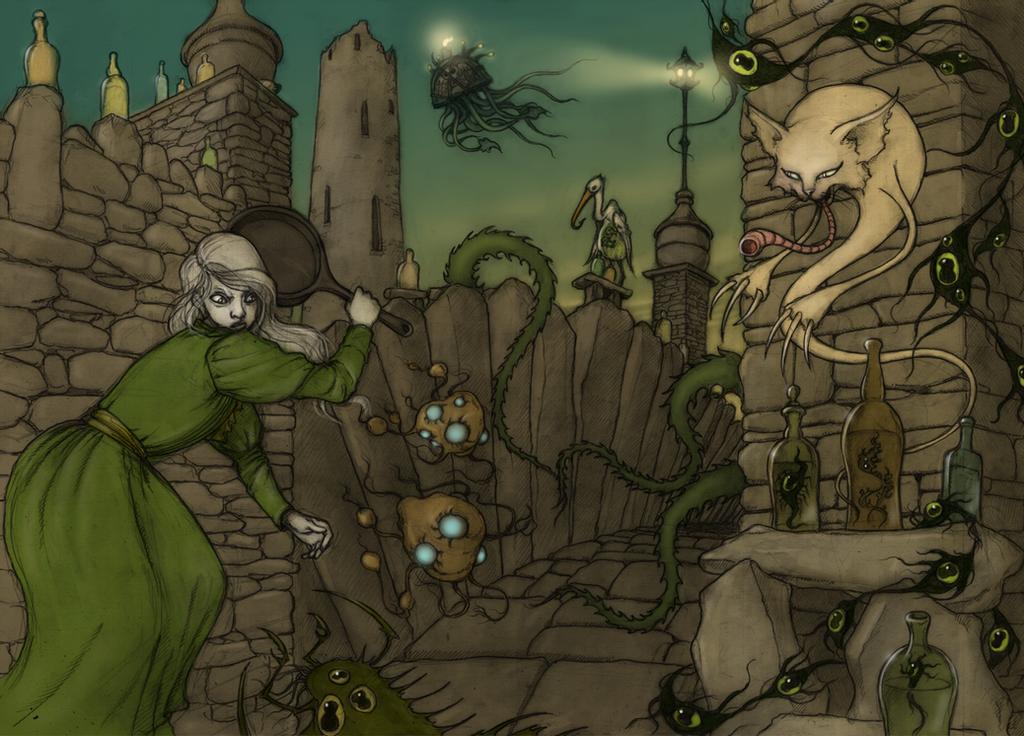
Lead research botanist and chemist of the Hopeless Horticultural Society
Notes on The Triple Ribbed Red Bloomers.
This fungi is most notable for its long thick stalk, its protruding, slightly bulbous, rounded tip and ovoid root stems than generally grow in pairs. Generally known to grow swiftly predawn and has been known to frighten both maidens and older women, when they come across one unexpectedly on as morning. There are rumours that adventurous young ladies have been known to seek out these woody tubers, but we of the society dismiss such suggestions as there seems to be no scientific reason for doing so.
The current research orphan, replacing the previous one who died some days ago of experimental pharmacology (see notes on toad licking below) is a feisty young lad. When we handed him a freshly gathered triple ribbed red bloomer however he became inordinately shy, bright red, and refused to talk about it. An effect that has been noted with adventurous young ladies as well.
It was posited this was all to doing with handling the thick stalk, we suspected a mild mood altering pharmacological agent that enters the body via the dermis but no one else but the young orphan seemed to be affected, though Mrs Krumpet, the house keeper, did burst out laughing when she saw him holding the fungi, somehow the sound of her laughter caused the effects of holding the parturient fungi to amplify.
Notes on Lesser Hollow Toad licking
There is a verity of Toad on the island that we believe is unique to lesser Hollow, a small wooded area with a deep blow of earth that has a pond at the bottom.
Some believe Lesser Hollow was formed by the toads themselves which live and breed vociferously around the pond but nowhere else on the island. The Lesser Hollow toads never sit on toad stools or go anywhere near a toad table. Instead, they frequently sit on each other. Mid breeding season (between March and October most years) the toads breed so quickly that they develop toad towers that sometimes reach up to the lip of the hollow, the highest recorded to our knowledge is a thirty-seven toad tower.
It was posited by Young Mr Candlewick of our sister organisation ‘The Hopeless Zoological Society’ that the reason the toads manage to make such high towers was that they excreted a stickly glue-like substance through their epidermis. In the spirit of cross society cooperation, we lent the HZS a research orphan, whom they encouraged to lick one of the toads to determine possible psychotropic properties of the dermis excretions. As they had read toad licking could be ‘quite fun’ in some odd journal that washed up after the shipwreck last month.
Sadly, they were unable to determine if any psychotropic properties were present as the glue-like nature of the toads skin slime caused the research orphan to get his tongue stuck to the toad. Attempts to remove the toad stripped away several layers of skin from the orphans face and then Mr Candlewick had to remove the lingua with a pair of sheers.
The orphan sadly expired due to blood loss, or possibly blood retention in his lungs, we are not sure which. His tongue, however. is still stuck to the back of the toad in question, and is now part of one of the largest toad towers ever seen on the island.
So, some success there.
We look forward to more cross experimentation with the zoological society in coming weeks when we intend to feed a night potatoes to dust-cats to see what will happen
Lead research botanist and chemist of the Hopeless Horticultural Society
It has long been established that almost all Toadstools on the island are poisonous to one degree or another. Notably the Death Night Cap, Old Widows Crust, Destroying Archangel, Fools Damp Funeral and Yellow-Strainer should all be carefully avoided.
The recent discovery of the new species Toadtables however we have discovered are perfectly edible. Native to the island they grow wherever you find other toadstools. Generally, in the middle of a patch of the fungi, with toadstools arranged around them in a suitable seating pattern.
Some scientifically uninformed individuals have said a toadtable is formed when several toadstools grow into each other forming a single long flat fungus with four or more stems but we of the Hopeless Horticulture Society refute this, we have determined it is definably a separate species and rigorous testing with our current research orphan has determined they are both nutritious and non-lethal.
The research orphan also reported a slight giddiness, weakness of the legs, feelings of elation, and then spent the better part of an afternoon in a semi-comatose state. Importantly though he did not die, which was a bonus as the next hiring fair is still three months away.
Having rigorously tested the Toadtable’s for basic edibility we progressed to stage two and brewed them into a nice tea which we surprised the research orphan with two days later, under the auspices of blind testing. One notes the research orphan was somewhat reticent to imbibe the tea, on account of a certain unfortunate wariness he has developed of late about things he is encouraged to partake of by members of the society.
Luckily the funnel and hose pipe delivery method worked just fine after we tied him down to the research chair.
It is to be noted that this can bias results due to unnatural stress placed upon the research orphan, and the effect upon his state of mind at been forced to partake.
The transcribed notes of the experiment also reflect this unfortunate methodology. It is difficult to be certain whether he called us all ‘A set of utter bastards’ and entreating us to ‘Go jump in the sea’ due to the tea increasing his innate aggression or just a reaction to being forcing to drink it.
His refusal to answer any of our questions about his state of mind, the effects of the tea and how he was feeling in general afterwards were frustrating. He has however developed an alarming twitch, bursts out laughing at irregular intervals and tried to run away three times.
This is a shame as we were going to write to Reverend Davis commending the robustness of our latest research orphan. We’ve not had one last this long before, and as you know the improved hardiness of research orphans is important for the advancement of science.
Further testing will be required, as we suspect will be a new research orphan come the next hiring fair.
There is a spring, on the island of hopeless. A spring from which no man drinks. Over the centuries the spring has cut a steep gorge down to the sea that no man found. The gorge leads to a beach of shale and grit sand that no man would call pretty. The tide is relentless here. Seaweed rots and dead things wash up twice each day. The decaying shells of broken boats litter the forgotten shoreline, but no man combs this beach.
The remains of a hut sits just above the high tide line. The roof long collapsed, one wall shattered by a storm ages ago. It is a hut now only because what remains remembers what it was. Beyond the hut a small jetty slumps, made by the same hands that made the hut. No man would walk upon it now. Even seagulls think twice before perching upon its posts.
At the end of the jetty sits the remains no man could name. A skeleton held together by a memory no man has. Clothed in rags that are more holes than cloth. The skeleton sits and stares out at the unforgiving sea, as once in life it sat there and waits. While the wind blows along the forgotten shore, and rain and spray lash at what was once waiting.
Each day, as the tide recedes from its apex, the thing that dwells in the sea comes. She is a thing no man has named. No man could name. Once someone did. She come and sing to the remains on the jetty. Her song, a song no man has heard for a long time. Not since the remains last struggled from their dying bed, out of his hut and along the jetty to listen to her one last time.
She comes, the thing that dwells in the sea. She comes to sing to her lover. She comes and sings and no man hears her. Least no man remembers hearing her. She comes and sings and no man weeps.
The tide recedes, the tide swells, and each day the thing that dwells in the sea comes to sing to no man. And no man weeps. And that which was remembers all that once was. In the cove no man would call pretty, the shade of no man remembers her lover, who visits her still.
Recently at the Raising Steam festival, Mark Hayes helpfully pointed his camera at The Ominous Folk. He’s now turned his videos into a blog post.
There are a couple of technical things here – because we’ve migrated to a different host, while we still look like a wordpress site we’ve lost the power to reblog, so we have to take a slightly different approach to sharing things.
Thing number two is that Mark is a lovely author who is hugely supportive of other authors. If he’s not on your radar already, do take a few minutes to explore his blog and get a sense of the wonderful creative things he does.
What we’re going to get in a bit is a charming little insert block (wait for it….) If this was a reblog we’d start with the opening text of Mark’s post and then there would be a link, so I shall try to replicate that effect….
“Probably because there was no one competent available I was asked to record the Ominous Folk of Hopeless Maine performance at Rising Steam 2023. So I did…
The first song is about demonic devices, which is to say it is a song form the perspective of a demon forced to power a device. Possibly a steam roller, may be a kettle, or possibly a really over engineers rotary washing line. Please remember not to try this kind of thing at home unless you have a 5th level summoning circle and an emergency banishing spell to hand…
In the aftermath of broken bottles and stamped on night potatoes no one was entirely sure what had happened. No one even admitted to having been there. The most anyone would admit was knowing someone who knew someone who had been there. There were no witnesses because no one was willing to admit to having been there and witnessing the event and by mutual unspoken agreement those who had seen others in attendance and been seen themselves never spoke of it directly.
Everyone one was however more than happy to apportion blame, as ever.
In this case though that blame was easy enough apportioned. It was the fault of the newcomer. The man in the red-tailed jacket who had washed up on the shores of the island less than a month before in most unlikely circumstances. Barham P Bingley. Just how he had washed up in a old but well maintained circus wagon bearing his name in salt damaged, peeling paint, no one was entirely sure. The residents of Hopeless were also unsure just how he had convinced them to help tow his wagon up from the beach to a small meadow just along the road from the bridge of bottles. Other things of which they weren’t entirely sure of included why they had parted with coin, food stuff and other odds-n-sods to sit on uncomfortable wooden benches and watch ‘The World’s 2nd Greatest Showman’s’ put on his somewhat limited show for several nights on the trot. Mostly the audience just left each evening feeling a little sad and in no small part sorry for the little man in his faded red coat, with his battered top hat and painted smile.
The shows were however over by early evening and the audience could all repair to the squid and teapot for a couple of pints afterwards. Also the little man and his show was the kind of thing the residents of Hopeless expected to come to some tragic end. If it wasn’t for the fact his name was boldly escribed upon his wagon, it would have had pathos written all over it. And while they might deny it, the folk of Hopeless could never resist watching another calamity happen before their eyes. As such it became something of a vogue to attend the makeshift show for the first few weeks of what the locals laughably referred to as early spring. Which was one of those dismal fog laden moist springs that never quite got the hang of not been a late winter.
After the first couple of shows, and the merger takings from ‘the passing of the hat’ Barham himself began coming to the pub as well, mostly to get out of the fog for a while and nurse what could, if you were being kind and had never tasted the real stuff, be called a small brandy. Whence he would further ‘entertain’ the locals with talk of the many strange places and strange things he had seen. The wonders of his shows in Paris, Milan, New York , London and Dulwich. He also took pains to explain how once his circus once consisted of a dozen elephants, a trio of trained sealions, A pair actual lions and a tiger name King Stripentooth the third.
What had happened to King Stripentooth the second and first he would not say but King Stripentooth the fourth was one of the few animals that had remained in his circus when he arrived, a small domestic tomcat who’s fur had been badly dyed with orange stripes, much of which had washed out by ocean spray. King Stripentooth IV had run off after their second night and not been seen by Barham. However, he took heart in the appearance of the occasional rodent corpse presented at the foot the caravans step each morning which suggested the cat was thriving on the island.
The residents chose not to dissuade him of this notation or mention something else leaving the corpses of dead rodents for the showman to step into each morning was equally possible. This was Hopeless after all.
Late one evening in a near empty bar, after his least successful show so far, Barham was lamenting his lot. The veneer of outgoing upbeat cheerfulness had been chipped away earlier that day when the matinee performance had netted him the princely sum of a half rotten turnip and two carrots that had seen better days. He would not have minded so much if this pitiful return for his endeavours had been placed in the hat in the traditional manner, but hurling rotten vegetables at him seemed both ungracious and somewhat ungrateful of his audience, most of whom for the matinée had been children from the orphanage.
“They must have like the show.” One of the other drinkers, sagely told him. “Poor sods don’t have much to eat up there, though Davies does his best by them.”
There were nods all round at this latter comment. Barham chose to let it pass. His only interaction with the islands resident man of god had been when the Reverend turned up to condemn the painted ladies and heathen gypsy fortune tellers that he knew frequented the circus. He had some wondered off somewhat aggrieved when he had discovered there were none.
Barham suspected Reverend Davies was disappointed by the absence of fallen women he could condemn. He had met such men before.
“I am sure the little scamps were delighted.” Barham said, working up the courage to drink some more of the local brandy.
“Well a whole turnip, that’s fair reward I’m sure,” said another of the sage drinkers.
“Yes well… I would not mind so much but I’m sure one of the ‘delightful little scamps,” nicked the spoon form my coffee mug as well while my back was turned.”
“Now Mr Bailey, there no need to accuse the kids of stealing, poor sods have naff all but they would nay nick a man spoon I’m sure, not around here.” The older of the sages said.
“Nar, that would be one of them spoon-walkers.” His younger compatriot put in.
Several nervous laughs issued forth from other drinkers. The kind of mocking laugh you get from people who know what has just been said is ridiculous and the kind of local legend parents tell kids to make them do the washing up and put the cutlery away. But while they all knew that’s all it was , all of them also knew spoons went walkabout all the time. And everyone had seen a spoon-walker at some point in their life, often after too much night-potato vodka…
“Ha, Spoon-walkers, you gonna tell him about dustcats next?” laughed the older sage.
“Dust-cats..?” Barham half inquired but then said, “No one thing at a time, spoon-walkers, what pray tell is a spoon-walker?”
“Well, they’re like, squidgy things than nick spoons so they can walk about on land without damaging there tenacles.”
“Really?” Barham said, showing more interest in such things than you might expect. But Barham P Baily was a Showman born. Strange creatures were his stock in trade, a stock he was woefully short of at this time. If this miserable island had some interesting fauna then being stranded here for some time may not be the worst thing to have happened after all.
“Aye, and they are dangerous too.” The young sage said, to more bouts of laughter
“Get off with yourself, nothing dangerous about spoon walkers.” The old sage piped up.
“You say that but I heard tell about a huge one a few months back, stamping around causing havoc over on the other side of the island.
“Oh that bat droppings. It was a Walloping Jenny not a spoon walker.” Another drinker put in.
“No I heard it was Spoon-Kong reborn.” Laughed a fourth.
And argument ensued, but Bailey wasn’t listening anymore, he was having visons of strange beasts walking about like stilt walkers. Towering beast. If they walked on spoons naturally then he could train them to walk with larger thing. If they weren’t scary he could make them so, Spoon-walkers, why if he could capture a few of these beasts and teach them to walk with knives… Stand amid them with a bullwhip and a chair, as you always needed a chair. Why lion taming was old hat, it had been done a hundred times over, but a knife-walker tamer. The crowds would flock…
The argument in the squid and teapot was raging for a while before Barham managed to cut through the din with his ringmaster’s voice…
“So tell me, just how exactly would one go about capturing one of these ‘spoon-walkers’?” he asked.
This, it was determined afterwards by the sage drinkers of drink, was the point at which things started to go wrong for Barham P Bailey.
Last week we said things about demon devices and how sometimes you just have to shove a demon in a blunderbus and get on with things. This led to Mark Hayes feeling moved to shove a demon in a blunderbus and take photos.
Mark is an excellent chap, and one of the Gloucestershire steampunks. (He’s not actually residing in Gloucestershire, but this seems to be a minor detail really).
… and the sort of person who turns out to own both a blunderbus and a demon, and to be possessed of the willingness to put these two things together and take photos of them.
Like many people who have washed up on the shores of Hopeless, Maine, Mark Hayes has told us many tales of his previous experiences. Some of those tales have been rather fanciful, and one always has the sense that he might be making things up. Which is, when you get down to it, probably why he is now dead.
This round of blood rain has brought us some unusual red plants – a rather cheering addition to our often drab and dreary landscape, I thought. Mark Hayes was the only one of us to react to them with absolute horror. He even suggested that we should set about destroying them at once on the grounds that they would take over everything. It reminded me (and no doubt others) of that time Ezekiel Marmalade tried to persuade us all that night potatoes are the seed of the devil and should be burned to ashes, rather than the better procedure of slightly charring them so they keep still while you eat them.
Mark Hayes went alone to try and wipe out what he called the menace of the red weeds. A few people went along to watch, but no one really took him seriously. I gather from them that the weeds resisted him strenuously. Some of them have gone so far as to develop faces, full of teeth. While horrified onlookers stood around and watched and made no effort to help, Mark was eaten by the plants.
The red weed appears to be expanding much as Mark said it would. Unfortunately, now that he’s dead we can’t find out anything useful from him about how to deal with it. Staying away from the teeth is clearly a good choice. Perhaps this is simply a natural extension of the natural cycle that brought us the blood rain, and thus we can expect something even more alarming to come along and eat the plants in the fullness of time.
In the meanwhile, we should all learn from the death of Mark Hayes – stay away from the red plants, and don’t do anything heroic. Just because a person turns out to be right about something being a problem, it doesn’t mean it is also advisable to leap into action. Apathy saves lives, but not all newcomers to the island always appreciate this.